
12 Location Tests Every Cafe Owner Must Run Before Signing a Lease

Most cafe owners fall in love with a space before they understand what that space will actually do to their revenue. Here’s the scouting framework that changes that.
Location is the one decision in your cafe business that you cannot undo cheaply. Everything else, your menu, your branding, your pricing, even your staff, can be changed. But a bad location will drain you slowly, quietly, and then all at once.
The problem? Most cafe owners evaluate location the wrong way. They walk in, feel the “vibe,” check the rent, and sign. That’s not scouting. That’s a gut feeling dressed up as a business decision.
These 12 tests will force you to see a location the way your revenue will, not the way your excitement does.

01 The 48-Hour Location Test
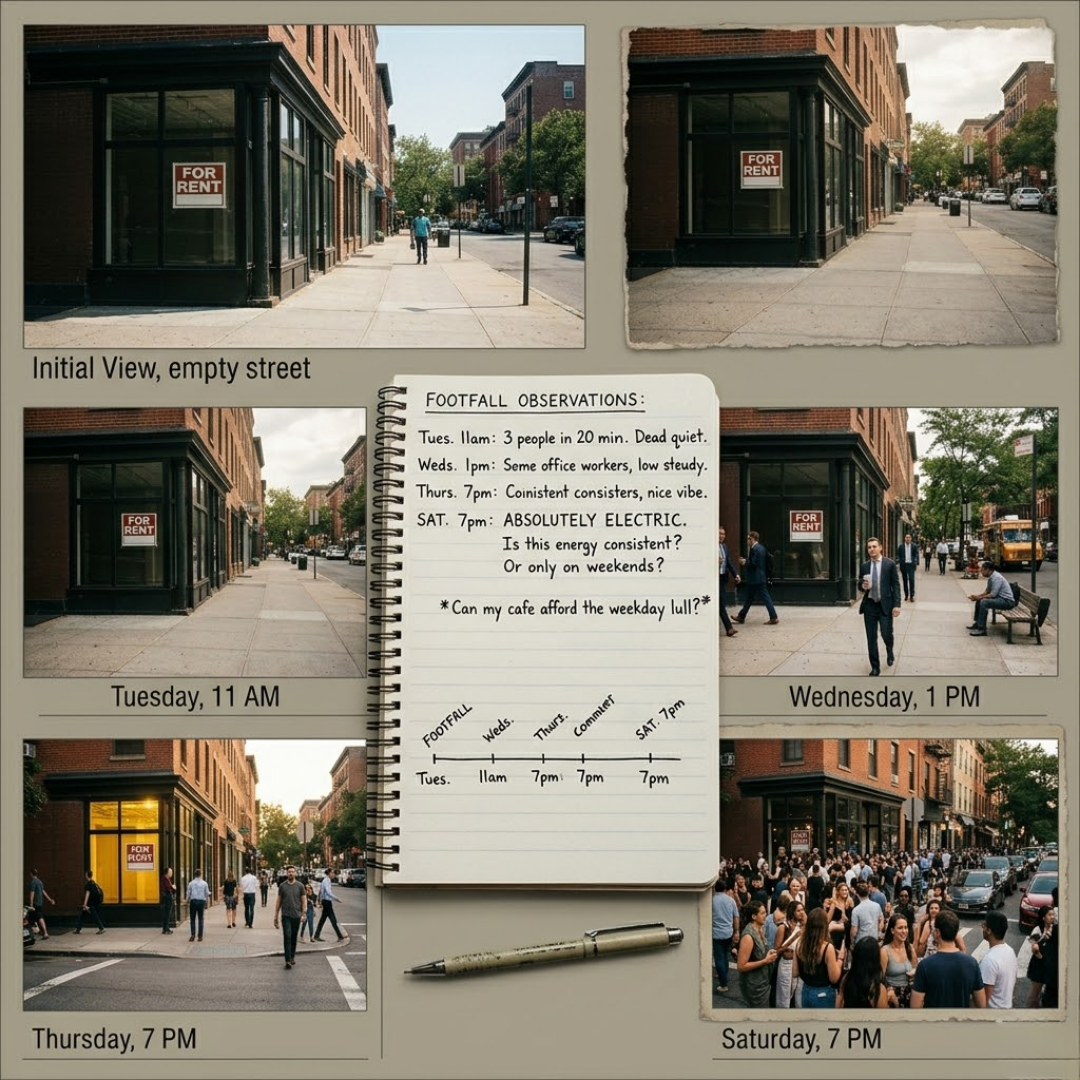
Don’t visit a location once and decide. Visit it four times, across two days, at different hours. Morning rush, lunch lull, evening crowd, and a weekend afternoon. A place that feels electric at 7pm on a Saturday can be a ghost town at 11am on a Tuesday.
Ask yourself: What time does footfall actually peak? Is the crowd consistent or wildly variable? Does the energy match your cafe’s intended vibe?
If a location only comes alive on weekends, your weekday revenue will make your break-even feel very far away.

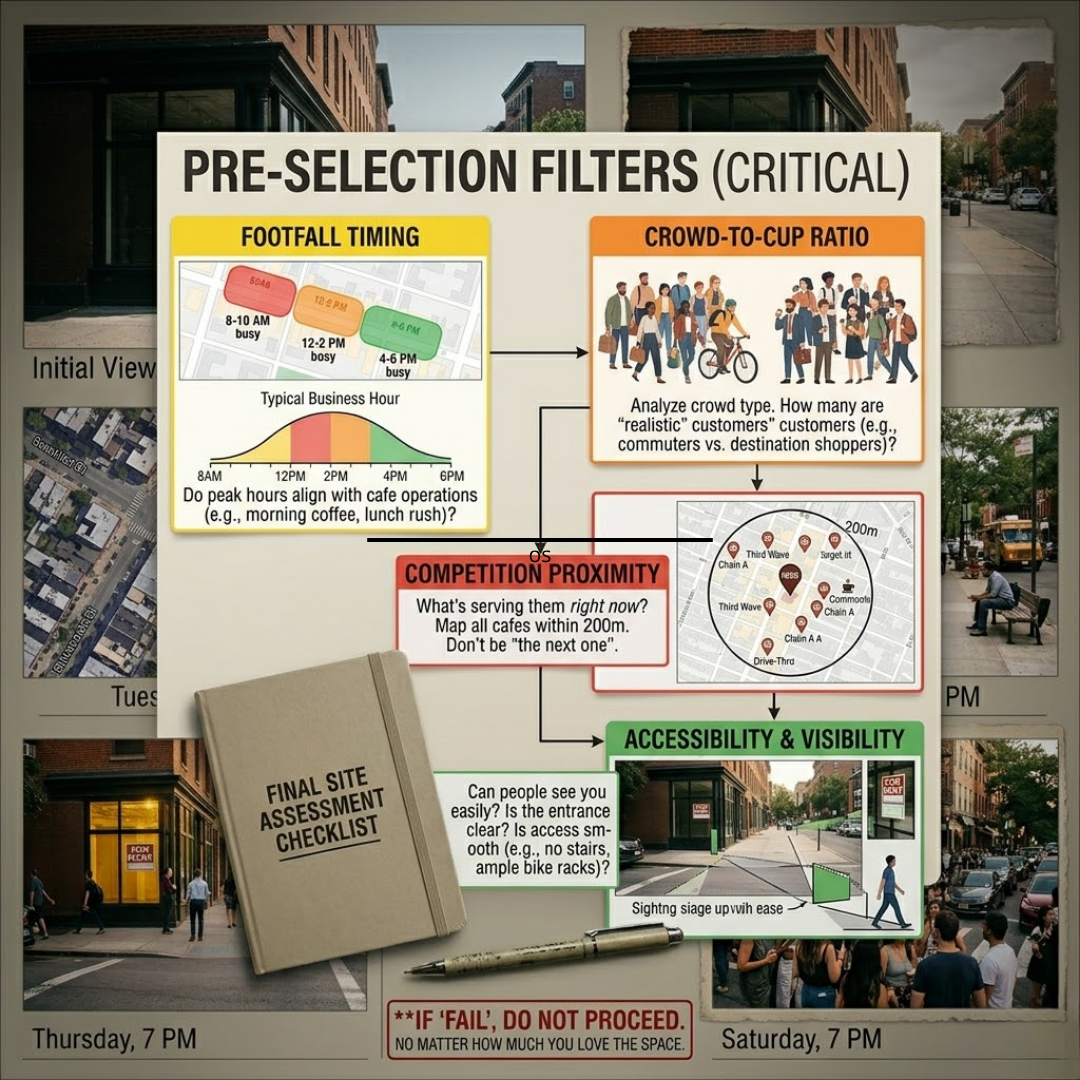
02 The 4-Filter Framework
Before anything else, run every location through these four filters in order. If it fails at any stage, don’t move forward, no matter how much you love the space.
Footfall Timing, Does the foot traffic match when your cafe will be open? Crowd-to-Cup Ratio, Of the people passing by, how many realistically want coffee right now? Competition Proximity, What’s already serving them within 200 metres? Accessibility & Visibility, Can people see you? Can they get to you easily?

03 The 100-People Walk Test
Stand outside the location for 30 minutes. Count 100 people walking past. Then honestly ask: How many actually looked at the storefront? How many slowed down? How many would realistically walk in?
The rule of thumb: If fewer than 5 out of 100 people even glance at your frontage, you have a visibility failure, not a marketing problem. No amount of Instagram ads will fix a location that doesn’t pull eyes.
04 The Anchor Store Test
Every high-footfall location has something that draws people there in the first place. A supermarket. A gym. A school. A hospital. An office complex. These are anchor stores, and they create habitual, recurring footfall that you get to benefit from.
Ask: What is the primary anchor pulling people to this area? Is it open during your peak hours? Do its customers match your target customer?
No anchor nearby means you’ll have to create footfall entirely on your own. That costs money, often lakhs in marketing, and months of patience you may not have.
05 The 500-Metre Resident Test
Your regulars, the people who come back twice a week and make your revenue predictable, almost always live or work within 500 metres of your cafe. Walk that radius. Count the residential buildings. Read the income signals, car brands, building quality, nearby stores. Understand who actually lives here: families, young professionals, or students.
If no one lives nearby, you are entirely dependent on pass-through traffic. That’s a high-risk, low-loyalty revenue model.
06 The Competitor Audit
Visit every cafe within 1 km. This is not optional. For each one, note their average bill size, their crowd type and age group, their real peak hours, and what is noticeably missing from their experience or menu.
If after all that research you still can’t clearly answer “why would someone choose us over them?”, the location will slowly eat you alive. Proximity without differentiation is just rent competition.
07 The Bad Day Test
Visit the location on a rainy day. A slow Tuesday afternoon. A public holiday. These are your “bad days,” and every cafe has them.
Does footfall drop to zero when it rains? Is the area completely dead on public holidays? A great location holds steady across conditions. If footfall collapses under any single variable, your monthly revenue will be wildly inconsistent, and inconsistency is what kills cafes, not slow days.
08 The Parking & Friction Test
Pretend you’re a customer. Actually arrive at the location four different ways, by two-wheeler, by car, by auto or cab, and on foot. Time each one. Notice every inconvenience.
Every friction point is a silent lost customer. In a car-heavy neighbourhood, zero parking doesn’t show up in your research, it shows up in your revenue three months in.
09 The Google Maps Ghost Test
Open Google Maps. Search “cafe near [location name].” Zero cafes nearby could mean an untapped market, or zero demand. Ten or more cafes means demand is validated, but you need a strong differentiator. Mixed ratings under 3.8 signals a quality gap that could be your opening.
Also check: are those cafes getting active reviews, or are the last reviews from two years ago? Active reviews mean an active community.
10 The Sunrise-to-Sunset Revenue Map
Map your potential revenue across the full day before you commit.
7–9 AM → Commuters, office crowd → High potential near offices 10 AM–12 PM → Freelancers, homemakers → Medium 12–2 PM → Lunch crowd → High near offices or colleges 2–5 PM → Slow hours → Low unless near colleges 5–8 PM → Evening hangout → High in residential/retail areas 8–10 PM → Dinner/dessert crowd → High in nightlife zones
If your location only delivers revenue in 2 of these 6 windows, your break-even just got significantly harder.
11 The 6-Month Future Test
A location perfect today can be dead in 8 months. Talk to local shopkeepers, check with the municipal office, or Google the area name with “construction” or “development.”
Is a metro, flyover, or road project coming? Is a new mall planned nearby? Is the area gentrifying or declining? A road diversion or construction block can cut your walk-in footfall by 60–70% overnight.
12 The Rent-to-Revenue Ratio Test
This is the test that turns all the others into a real business decision.
Your monthly rent should not exceed 8–10% of your projected monthly revenue.
If rent is ₹80,000/month, your cafe needs to realistically generate ₹8–10 lakh/month to be sustainable. Not optimistically. Realistically. Use your revenue map to estimate daily covers, apply your average bill size, and run the math before you fall in love with a space.
Most cafe owners skip this calculation, or do it optimistically. The rent-to-revenue ratio is the one number that separates a business decision from an expensive dream.

One Comment